iceliesk.xyz
German Chancellor Friedrich Merz on Monday said that 80% of the more than 900,000 Syrian nationals in Germany should return to their home country in the next three years.
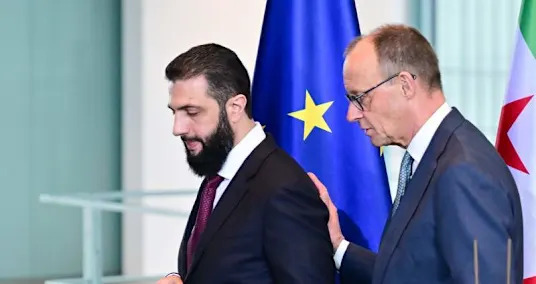
Speaking at a press conference during Syrian interim President Ahmed al-Sharaa's first visit to Berlin, Merz said that Syrians are needed at home to join reconstruction efforts, while stressing that those "who wish to remain in Germany and are well integrated will be able to stay in Germany."
Germany was one of the main destinations for Syrian refugees fleeing the country's devastating civil war under dictator Bashar al-Assad, taking in far more than any other EU country.
Many thousands reached Germany in 2015-16 when chancellor Angela Merkel decided to open the borders to refugees, and the issue has a particular political sensitivity in the country.
Many have since become German citizens, but calls for Syrian nationals to leave Germany have risen in conservative and far-right circles following al-Assad's ousting in late 2024 by an Islamist coalition led by al-Sharaa.
"Over the longer term of the next three years - that was the wish of al-Sharaa - 80% of the Syrians currently in Germany should return to their homeland," Merz said, according to a transcript distributed by the Federal Press Office after the press conference.
Merz said the majority of Syrians want to return to their country, rebuild it and live in safety, freedom and dignity.
The chancellor added that al-Sharaa has said returning Syrians would be "welcome."
"That is surely the key message of your visit here in Berlin today," Merz told the Syrian leader.
Merz also said he has asked al-Sharaa to prioritize the repatriation of Syrians who no longer held a valid residence permit in Germany, as well as those guilty of criminal acts.
"We have a small group here, but one that is causing us problems – Syrians who have committed criminal offences, whom we now wish to repatriate as a matter of priority," the chancellor said.
Al-Sharaa thanks Germany
According to official government figures, a total of 940,401 Syrians lived in Germany in November 2025. A total of 512,348 enjoyed protected status, including those eligible for asylum.
Since January 2025, at least 9,777 Syrians have left Germany voluntarily, according to the Interior Ministry.
Merz said that he and al-Sharaa had touched on the many Syrians who have been working in the German health care sector.
While Germany had a vested interest to make sure the many doctors and nurses working in German hospitals remain in the country, "many of those who are here are needed at home," Merz said.
Al-Sharaa thanked Germany for taking in Syrian refugees.
"We will never forget how you opened your doors to a million Syrians when they were in dire need and all other doors remained closed to them," said al-Sharaa. "You have given our children the opportunity to learn, to work and to build a new life for themselves."
Syria's reconstruction is beginning now and Syrians living in Germany can contribute to this, he said.
Reconstruction efforts
Political stability and economic growth in Syria will be crucial to the success of the reconstruction effort, Merz stated.
"And those returning to Syria with new experiences and ideas gained during their years in Germany and around the world should play a key role in this," he argued.
Rebuilding schools, nurseries, hospitals and businesses in Syria will require an enormous effort, and Germany intends to support the country's reconstruction, Merz said, announcing the formation of a task force on the issue.
Berlin is providing more than €200 million ($230 million) this year to help stabilize the country, according to the chancellor.
"You can count on Germany's support on the path to a bright future," Merz told al-Sharaa.
He encouraged the Syrian leader to create space for all people in the new Syria, regardless of their religion, ethnicity or gender.
"Violence against minorities and those with differing views must be a thing of the past," he underlined.
Protests in Berlin
Al-Sharaa's first visit to Germany was accompanied by demonstrations, with both opponents and supporters of the new Syrian leader taking to the streets of Berlin.
Seven rallies drawing hundreds of participants were held across the capital and were mostly without incident, according to police.
A large police contingent of 1,700 forces was deployed across the capital during the visit, with several streets in the government district cordoned off.
The largest rally saw some 600 al-Sharaa supporters gather outside Berlin's central station, which is located near the Chancellery, according to police.
Some 15 people were seen protesting against al-Sharaa outside the German Foreign Office, accusing him of violence against Syrian minorities.

Latest Articles
- 1
 Must-See Attractions in Washington, D.C.
 - 2The Ursid meteor shower will be the last of the year, peaking just before Christmas: What to know and how to watch
- 3Find Wonderful Stream Voyage Objections On the planet
- 4How did I get my own unique set of fingerprints?
- 5IDF destroys two-kilometer-long Gaza terror tunnel in Beit Lahiya


Related Articles