iceliesk.xyz
When you buy through links on our articles, Future and its syndication partners may earn a commission.

Once at a space conference I attended in Colorado Springs, NASA astronaut Victor Glover — the pilot of NASA's upcoming Artemis 2 mission to the moon — said something that caused a bit of a stir.
It was April 17, 2023, just two weeks after NASA had named Glover to the Artemis 2 crew, a lunar flight that will make him the first person of color ever to visit the moon. Glover was there at the Space Symposium conference with other astronauts to talk about, well, space.
But he also told a group of reporters about his weekly tradition: Every Monday, he listens to "Whitey on the Moon" on the way to work at NASA's Johnson Space Center in Houston.
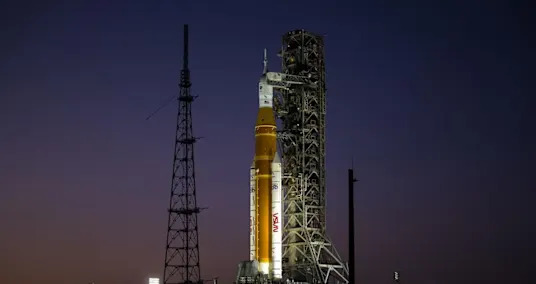
Glover happens to be Black. And now he's going to the moon. NASA is targeting April 1 for the launch of Artemis 2, which will send Glover and three other astronauts on a 10-day lunar flyby mission.
"It's funny, because that Space Symposium caused me a lot of grief in the next months because people tried to quote me out of context," Glover told me in an interview last September. "And it ain't about racism. It's about the human condition."
"Whitey on the Moon" is a spoken-word poem by Gil Scott-Heron published and set to music in 1970. It recounts the challenges of doctor bills, taxes and high rent for Black Americans at a time when the U.S. was spending billions to send astronauts to the moon and beat the Soviet Union during the Cold War space race. You can read the full poem here.
It begins:
A rat done bit my sister Nell.
(with Whitey on the moon)
Her face and arms began to swell.
(and Whitey's on the moon)
I can't pay no doctor bill.
(but Whitey's on the moon)
Ten years from now I'll be payin' still.
(while Whitey's on the moon)
"That song is a reminder that everybody wasn't having a good time in 1968 when we launched the first Apollo missions. People were struggling," Glover said. "Some people were like, 'These bills and these potholes, like my condition hasn't been improved by NASA.'

Glover, 47, who grew up in Pomona, California and has four daughters (named Genesis, Maya, Joia, and Corinne) with his wife Dionna. He started listening to Scott-Heron's song and poem as a way to keep a perspective that many people out there aren't space-loving cheerleaders, and as a way to share that perspective with his colleagues.
"That song reminds me that, at that time, that community, which is very similar to the community I grew up in, they didn't feel heard," Glover told me. "And so it's a reminder to me that there are more perspectives and more stories out there than you'll hear from the people cheering for NASA on a regular basis."
"But those people? We work for them too."
The public revelation of Glover's "Whitey on the Moon" tradition may have given him some grief, but it was hardly the first time he'd shared personal opinions about social justice.

In June 2020, after the murder of George Floyd by then-police officer Derek Chavin in Minneapolis, Glover took to what was then Twitter (now called X) to share his feelings.
"My heart is low, my head is level, and my faith is high. So much to process, if you're struggling, that's OK," he wrote at the time. "I see you, I am you. Let's dialogue. Let's think. Let's Work."
One critic, in a post that has since been deleted, asked why Glover couldn't just stick to space.
"Actually no. Remember who is doing space. People are," Glover replied. "As we address extreme weather and pandemic disease, we will understand and overcome racism and bigotry so we can safely and together do space. Thanks for asking."
But getting back to "Whitey on the Moon," Glover said the perspective from the poem is important because, for some, there has never been any other way to look at life.
"I have never had the option to not have that perspective. I am a Black man in America," he said while speaking with Axios in 2023 at the Space Symposium. (I was there recording.) "I grew up with this."
"I live in the America that sent me to space, [and] told my grandfather he couldn't fly during the Korean conflict when he was enlisted," Glover added. "We live in a very complicated country."

Glover, a U.S. Navy Captain and test pilot, joined NASA in 2013 and first flew to space on SpaceX's Crew-1, a six-month mission to the International Space Station.
"When I came to NASA, they said, 'Hey, we hired you because of who you are,'" Glover told Axios. "Okay, cool. You get all of it."
Last September, during his interview with me, Glover said that our complicated country was on full display during the Apollo missions, which flew at the end of a turbulent decade filled with civil rights protests.
After the assasination of Martin Luther King on April 4, 1968, his successor, Ralph Albernathy rallied some 500 demonstrators, mostly Black, to protest the Apollo 11 moon mission's launch at the gates of NASA's Kennedy Space Center in Florida. It's the same spaceport that Glover and his crewmates will launch from on Feb. 8.

Abernathy and demonstrators brought two mules and a wooden wagon as a stark contrast to Apollo 11's mighty Saturn V rocket, a reminder that the U.S. was paying for moon rockets while others struggled to afford food and housing.
"The NASA administrator went down himself and talked to him," Glover said of Abernathy and then-NASA Administrator Thomas Paine. "And by the end of that conversation, that group of people that was at a protest prayed for the safety of those astronauts in that mission, because they had a human moment."
"They talked, and they heard, and were heard," Glover told me. "And I think that is a lesson."
Latest Articles
- 1
 Kaiser Permanente affiliates to pay $556 million to resolve US claims alleging Medicare fraud
 - 2Shelby County deputies charged with assault, placed on leave
- 3Here's what can happen if you drive under the influence of pot
- 4Holiday destinations for Creature Sweethearts
- 5Iranian rockets hit Tel Aviv area, injuring six





Related Articles